


Let our team help you select the right product
Talk to our experts, we can help you meet your requirements and provide assistance for your next project.
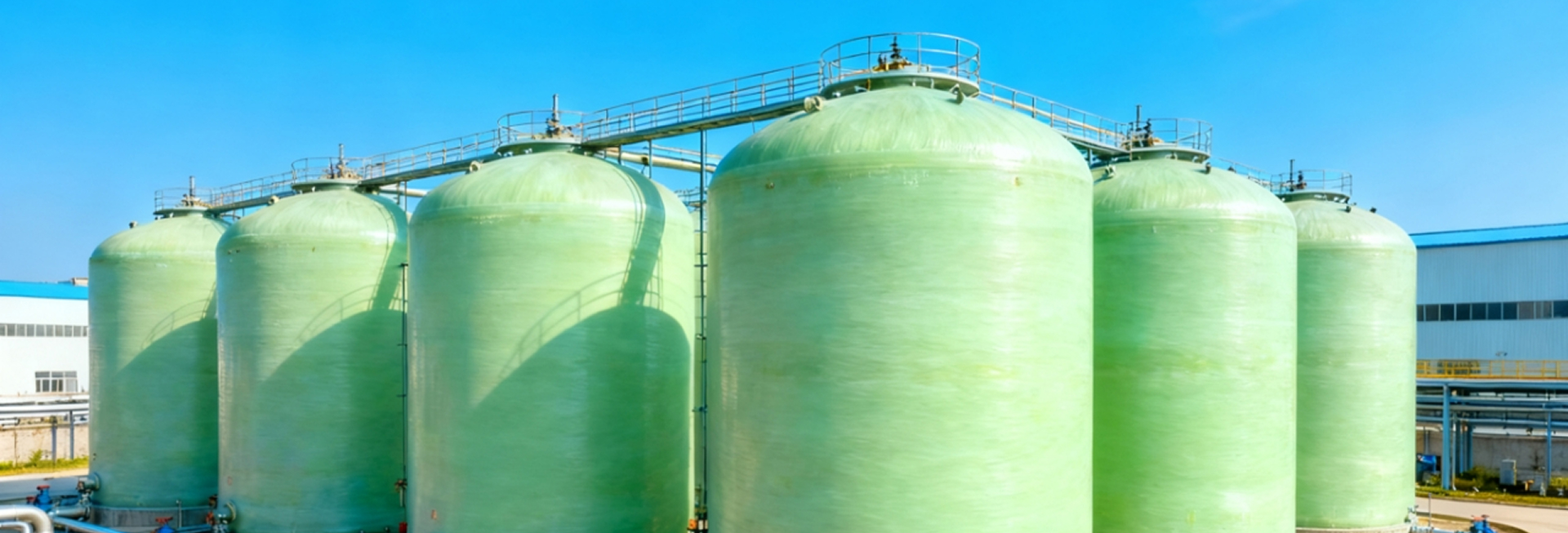
FRP TANK


A FRP Rinse Tower is an environmental protection device that uses liquid (usually water or chemical absorption liquid) to come into contact with polluted waste gas, thereby removing pollutants (such as dust, acidic gases, alkaline gases, organic waste gases, etc.) from the gas.
Products Description
Our fiberglass rinse towers are high-performance FRP (Fiberglass Reinforced Plastic) towers designed for industrial rinsing and washing processes. As a leading FRP rinse tower manufacturer and fiberglass rinse tower supplier, we provide corrosion-resistant, durable, and custom-designed towers for chemical, food, pharmaceutical, and wastewater treatment industries.
A fiberglass rinse tower is a vertical or modular FRP structure used to perform rinsing, scrubbing, or washing operations in industrial processes. These towers are highly resistant to corrosion and chemicals, lightweight, and easy to install. Compared to steel towers, FRP rinse towers require lower maintenance and offer a longer service life.
| Tower Diameter | DN600 mm – DN3000 mm |
| Tower Height | 3m – 30m (customizable) |
| Material | FRP / GRP (Fiberglass Reinforced Plastic) |
| Resin Options | Vinyl ester, Epoxy, Polyester |
| Design Standards | ASTM D3299, ASME RTP-1, BS4994 |
| Internal Packing | Raschig ring, Pall ring, Saddle ring |
| Temperature Range | -40°C to 120°C |
| Operating Pressure | 0.1 – 0.6 MPa (customizable) |
| Service Life | 20+ years |
Excellent corrosion resistance against acids, alkalis, and chemicals
Lightweight construction, easy to transport and install
Durable and low-maintenance design for long-term industrial use
Customizable dimensions and packing materials to fit process requirements
Cost-effective alternative to stainless steel or carbon steel towers
Suitable for high-efficiency rinsing and scrubbing applications
Our fiberglass rinse towers are widely used across industries:
Chemical washing and scrubbing processes
Pharmaceutical and food processing rinse systems
Wastewater treatment and industrial effluent scrubbing
Desalination and water purification plants
Industrial cooling and cleaning towers
Environmental protection and air/water scrubbing systems
We provide fully customizable FRP rinse towers to meet your project requirements:
Custom tower diameter and height
Choice of resin based on chemical compatibility
Internal packing types (Raschig, Pall, Saddle rings)
Custom nozzles, flanges, and access points
Modular assembly or field erection for large towers
Insulation, coatings, and reinforcement options
Our fiberglass rinse towers are manufactured in compliance with international standards to ensure performance, reliability, and safety:
ISO-certified production process
Advanced filament winding technology for structural integrity
Experienced engineering team with quality control at every step
Export-ready packaging and logistics for global shipments
Professional fiberglass rinse tower manufacturer with years of industrial experience
Ability to design and fabricate large and custom towers
On-site assembly support for modular or field-erected towers
Competitive factory pricing with fast delivery
Technical consultation and engineering support available
High-quality standards with rigorous testing
Looking for a reliable FRP rinse tower manufacturer or a custom fiberglass rinse tower? Contact us today to receive a professional design recommendation and a competitive quotation within 24 hours.
Please provide the following information to get an accurate quote:
Tower dimensions (diameter and height)
Operating pressure and temperature
Type of chemicals or liquids to be treated
Installation location and requirements
Customization requests (packing, flanges, modular assembly)
We are committed to delivering high-quality fiberglass rinse tower solutions for your industrial applications.
I. Core Definitions and Working Principles
A FRP Rinse Tower is an environmental protection device that uses liquid (usually water or chemical absorption liquid) to come into contact with polluted waste gas, thereby removing pollutants (such as dust, acidic gases, alkaline gases, organic waste gases, etc.) from the gas.
Its core working principle is gas-liquid mass transfer.
Waste gas entry: Waste gas containing pollutants enters the tower from the bottom.
Reverse contact: The exhaust gas flows upward, while the absorbent liquid is sprayed downward through the spray system at the top of the tower.
Mass transfer process: The waste gas and the absorbent liquid come into full and turbulent contact in the packing layer . Pollutants (such as SO₂, HCl, NH₃, etc.) diffuse from the gas phase to the liquid phase, where they are absorbed or undergo chemical reactions.
Gas-liquid separation: The purified gas continues to rise, passes through a demister to remove entrained liquid droplets, and is then discharged from the top of the tower.
Liquid circulation/discharge: The liquid that has absorbed pollutants falls to the bottom of the tower. Part of it can be recycled, and part of it is discharged as wastewater for treatment.
II. Why choose fiberglass to manufacture the flushing tower?
This is precisely where the advantages of fiberglass materials lie:
1. Excellent corrosion resistance (the most critical advantage)
Industrial waste gases often contain highly corrosive components such as acids, alkalis, and salts (e.g., sulfuric acid mist, hydrogen chloride, hydrogen fluoride, etc.). Fiberglass, especially when made with vinyl ester resin or epoxy resin , can perfectly resist the corrosion of these media and has a lifespan far exceeding that of carbon steel (even carbon steel with its internal anti-corrosion lining is easily damaged).
2. Lightweight and high strength
Lightweight, easy to transport and install, especially suitable for installation on rooftops and other similar locations. High strength and good structural stability.
3. One-piece molding, without welds
It avoids the risk of weld cracking like in plastic products, and also avoids electrochemical corrosion at metal weld joints.
4. The inner wall is smooth and does not easily accumulate scale.
With low fluid resistance, it is less prone to dirt adhesion, reducing the frequency of clogging and cleaning/maintenance.
5. Flexible design
The tower's size, number of spray layers, and packing type can be flexibly designed based on parameters such as the air volume to be treated and the type of pollutants.
III. Types and Application Areas
Based on the nature of the waste gas being treated, flushing towers are mainly classified into the following categories:
| type | Acid mist purification tower | Alkali mist purification tower | Organic waste gas scrubbing tower | Dust removal cooling tower |
| Processing objects | HCl, H₂SO₄, HNO₃, HF, etc. | NH₃, NaOH mist, etc. | Dust-containing soluble organic waste gas | High-temperature flue gas and dust |
| Absorbent liquid | NaOH solution , Na₂CO₃ solution | Dilute acid solutions (such as sulfuric acid) | Water, or certain chemical solvents | water |
| Working principle | acid-base neutralization | acid-base neutralization | Physical absorption, dissolution | Cooling, humidifying, and dust removal |
| Application industries | Chemical industry, electroplating, pickling, semiconductor | Fertilizer, petrochemical, and wastewater treatment | Spraying, printing, food processing | Boiler flue gas |
Summarize
Fiberglass reinforced plastic (FRP) scrubbing towers are one of the most economical and effective technologies for treating industrial acidic/alkaline waste gases and water-soluble pollutants. Based on the corrosion resistance of FRP, they purify waste gases through mass transfer in the packing layer and the chemical action of the spray liquid. When selecting a FRP scrubbing tower, the composition, concentration, temperature, and flow rate of the waste gas must be clearly defined to ensure precise design and selection, guaranteeing compliance with emission standards.
Let our team help you select the right product
Talk to our experts, we can help you meet your requirements and provide assistance for your next project.