


Let our team help you select the right product
Talk to our experts, we can help you meet your requirements and provide assistance for your next project.
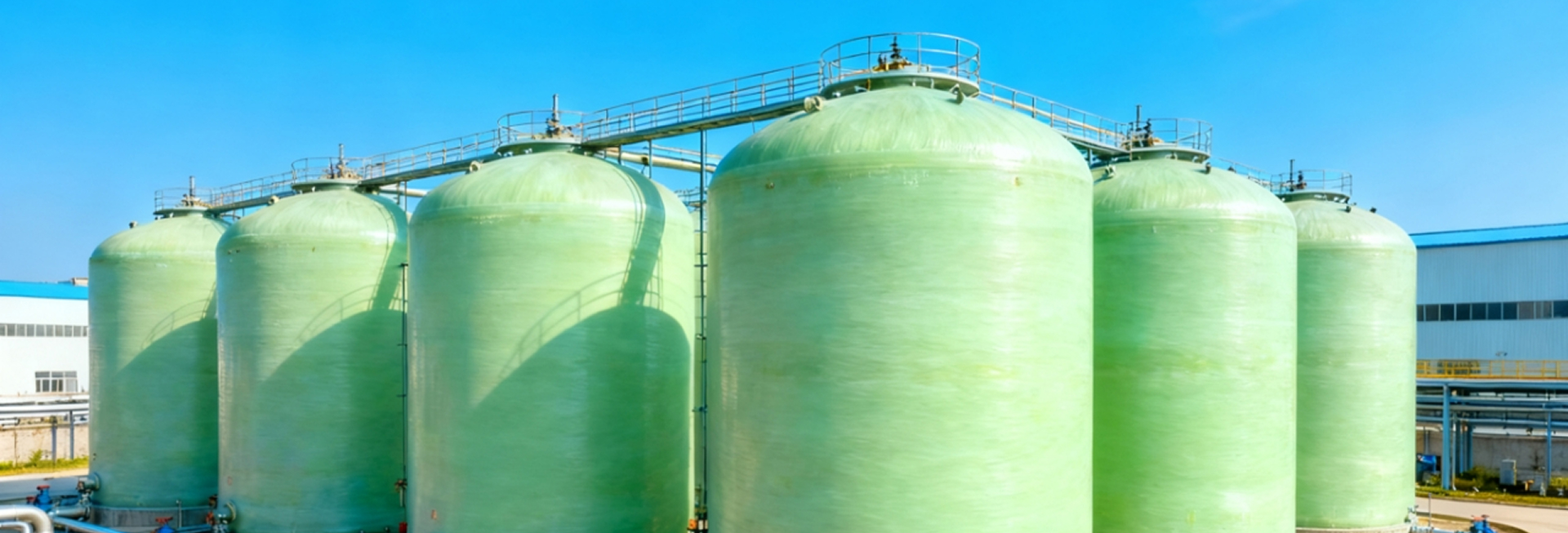
FRP TANK

This is a highly professional and efficient waste gas treatment device, which can be seen as an advanced application of the flushing tower. It does not merely absorb pollutants into the liquid, but achieves pollutant reduction and resource recovery, offering significant economic and environmental advantages.
Fiberglass Concentration Tower
The Fiberglass Concentration Tower is a specialized type of FRP Tank engineered for high-efficiency waste gas treatment. Unlike simple absorption towers that only capture pollutants, this advanced system focuses on reducing large volumes of low-concentration volatile organic compounds (VOCs) into smaller, highly concentrated streams. This process not only makes subsequent destruction or recovery more economical but also supports resource reclamation. As a critical functional module, it acts as either a pre-treatment unit to protect downstream equipment or a direct purification solution.

This Fiberglass Concentration Tower is most commonly integrated into systems like a zeolite rotor concentrator. Here’s a simplified breakdown:
Pre-Treatment: The tower first removes particulate matter and adjusts humidity from the incoming waste gas, protecting the delicate zeolite rotor or activated carbon downstream.
Concentration: Cleaned, dilute gas passes through the slowly rotating zeolite rotor, where VOCs are adsorbed. The rotor then rotates into a smaller "desorption" zone.
Desorption: A small stream of heated air is passed through this zone, releasing the trapped VOCs as a highly concentrated, low-volume gas.
Result: This concentrated gas is ideal for efficient destruction (e.g., in a small combustion unit) or for solvent recovery, dramatically reducing energy use and equipment size.
Excellent corrosion resistance (the core reason)
Whether it's acidic or alkaline dust during pretreatment or potentially corrosive combustion products (such as SO₃ forming sulfuric acid) during posttreatment, fiberglass can provide comprehensive protection.
Low surface energy, not easy to adhere
The smooth inner wall makes it less likely for resin or sticky contaminants to adhere, reducing clogging and cleaning hassles.
Temperature resistance and dimensional stability
Although it does not come into direct contact with the highest temperature combustion gases, a good resin system can withstand temperature fluctuations during pretreatment and processing.
Lightweight and high strength, easy to mold
It can manufacture large, non-standard shaped towers to accommodate complex engineering layouts.
1. Protect core assets: As a pretreatment tower, it can effectively protect expensive zeolite rotors or activated carbon, extend their service life, and is a prerequisite for the long-term stable operation of the entire concentration system.
2. Achieve waste gas reduction: In conjunction with the rotary drum, it transforms large volume, low concentration waste gas into small volume, high concentration waste gas, which significantly reduces the size and energy consumption of subsequent combustion treatment equipment, achieving the effect of "doing big things with a small furnace" , and is extremely economical.
3. High-efficiency purification: When used as an absorption tower to treat specific pollutants, it can directly and efficiently remove the target substances.
4. High system integration: FRP towers can be easily integrated with pipes, pumps, water tanks, etc., to form a complete processing unit.
Fiberglass thickening towers are used in all industries that need to treat large volumes of low-concentration VOCs waste gas, and are a "must-have" piece of equipment under current environmental protection policies.
Coating & Spraying: Automotive, furniture, and appliance painting lines.
Printing & Packaging: Flexible packaging and rotogravure printing processes.
Electronics: Semiconductor cleaning and LCD manufacturing.
Chemical & Pharmaceutical: Fine chemical synthesis and API production.
Rubber & Plastics: Tire manufacturing and rubber vulcanization.
The fiberglass concentrator should not be viewed in isolation as a single device, but rather as a key functional module in a high-efficiency waste gas concentration and purification system .
Its main role is that of a "guardian" – at the front end of the system, it acts as a pretreatment tower, protecting the core concentration equipment (zeolite rotor).
In certain circumstances, it can also be a "terminator" —directly absorbing and treating specific contaminants after concentration.
Its value lies in the corrosion resistance of fiberglass , which ensures the long-term, stable, and efficient operation of the entire high-tech, high-investment concentration system, ultimately helping companies achieve ultra-low emissions and VOCs reduction at a lower operating cost. When selecting a system, its design and choice must be considered from the perspective of the entire system's process.
High Cost of Treating Large Air Volumes: Instead of building a massive incinerator to handle all the air, the tower concentrates VOCs, allowing for a much smaller, cheaper "polisher."
Protecting Expensive Core Equipment: As a pre-treatment tower, it captures sticky particulates and corrosive substances that would otherwise permanently damage expensive zeolite rotors or activated carbon beds.
Meeting Stringent Emission Regulations: It enables efficient removal of VOCs, helping facilities comply with tough environmental standards.
Energy Inefficiency: By reducing the volume of gas needing heating or treatment, it drastically cuts energy consumption for the whole system.
To ensure long-term, trouble-free operation of your Fiberglass Concentration Tower, consider these points:
System Integration: This tower rarely works alone. Its design (size, material, internal structure) must be perfectly matched to the entire system's process flow and the specific chemical nature of your exhaust.
Material Selection for Corrosion: While FRP is corrosion-resistant, the specific resin type must be chosen based on the exact chemicals present (acids, alkalis, or solvents) to avoid premature aging.
Temperature & Chemical Limits: Confirm the tower's operating temperature range and resistance to the specific VOCs. High temperatures or incompatible solvents can damage the FRP and internals.
Pre-Filtration Needs: Heavy particulate loads require effective pre-filters before the gas enters the tower to prevent clogging of the rotor or downstream media.
Choosing Pipezy for your Fiberglass Concentration Tower means gaining a partner focused on long-term, reliable performance:
Proven Expertise: With over 20 years of experience, Pipezy has successfully delivered large-scale FRP concentration towers for major projects, including desulfurization wastewater zero-discharge systems for power plants.
Full-Service Support: Pipezy provides a complete package—from custom design and manufacturing to transportation, on-site installation guidance, and commissioning. Their professional design team optimizes the structure for your specific needs.
Compliance & Adaptability: Pipezy ensures products meet international standards (ISO, CE). They also offer tailored solutions for extreme climates, including UV-resistant gel coats for intense sunlight and high-temperature resin systems.
Reliable After-Sales: Benefit from rapid remote technical support, detailed English documentation, and optional on-site service for complex installations, ensuring worry-free operation.
Let our team help you select the right product
Talk to our experts, we can help you meet your requirements and provide assistance for your next project.